I use ChatGPT, Claude, and Perplexity throughout my research and writing process. They help me investigate questions, test hypotheses, find sources, organize material, challenge weak assumptions, and produce most of the initial prose. I do that openly because the newsletter is about how a working photographer and sole proprietor can use these tools in the actual operation of a business, not as a novelty and not as a substitute for having something to say.
I wrote in the first issue of this newsletter that judgment does not disappear when tools improve. It moves to a different place in the process. This is what that looks like in practice. Go ahead, read the full article. The rest will be here waiting.

The work begins before the draft. I start with a problem I have encountered in my own business, form a hypothesis, run tests, collect evidence, and work through what the results mean. That often includes long written exchanges, dictated notes, original tools I have built, outside research, and repeated attempts to clarify the argument before I ask for a full draft. The models work from a detailed writing guide, established business facts, documented terminology, audience context, and lessons carried forward from previous articles.
Once a draft exists, I edit it, question it, add examples, remove language that weakens the argument, check externally verifiable claims, and decide what remains. I add the photographs, captions, artwork, structure, and final context. I also review what the process taught me and update the writing system so the next article reflects those decisions more accurately.
AI usually writes most of the first complete draft because it can turn a large body of directed material into prose faster than I can type it myself. It does not decide what I believe, what the evidence supports, what the article argues, or what I publish.


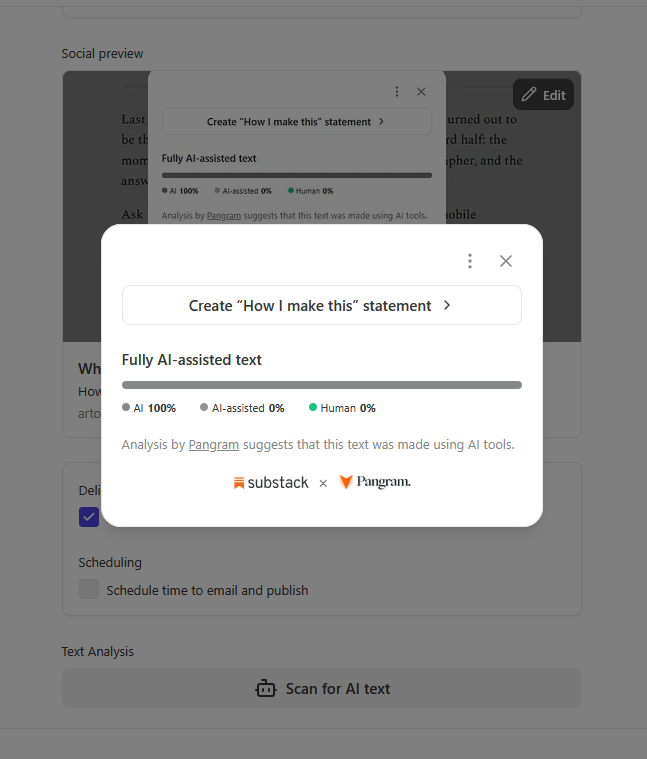
Pangram may describe the surface of that workflow as “AI 100%, Human 0%.” I do not. That score can identify the tool that produced much of the sentence-level wording. It cannot measure the research, judgment, experience, direction, revision, or responsibility behind the finished work. Treating those two things as equivalent mistakes a production method for an account of authorship.
I do not think my own score proves how well or badly Pangram works across Substack. It does expose a question worth testing. I am considering a small study built around writers with documented workflows, comparing fully hand-written work, corrective AI use, directed AI drafting, and unattended generation. The useful question is not simply whether Pangram detects machine-produced wording. It is whether the label it gives readers accurately describes how the work was made.
If you publish on Substack and can document your process candidly, I would be interested in hearing from you.
The tools are part of how I make this. They are not the reason it exists.