A few months ago, I posted in a Tucson photography group about a PPA workshop I was planning. The workshop would teach photographers how to use AI in their businesses, with an emphasis on workflow. The post received no acknowledgement. It’s a fast-moving group, so it disappeared under newer posts, and I let it go.
About two months later, the moderator announced that the group would no longer allow AI. Its About section now says:
No generative AI or LLM-created images, mood boards, flyers, content, or copy. This is an AI-free group.
I don't know if my post had anything to do with the new rule. What is clear is the boundary the group has drawn—one that now blocks not just AI images, but AI-assisted writing and planning materials, too.
I’ve felt this tension for some time. I use AI openly, and I write a newsletter about using it in a working photography business. Among my contacts in Tucson’s arts community, AI often feels like a dirty word. I want people to respect the work I put into the world and I also think I have something useful to share. Those interests meet in this newsletter, where the subject itself can affect how someone receives the work.
A familiar task with a different mechanism
Part of the difficulty starts with what we mean by using AI.
“Workflow” describes a tool’s role in the work. “Generative AI” describes how it operates. The same tool can be both. We’ve removed blemishes and distractions in Photoshop and Lightroom for years. Adobe’s Generative Remove uses Firefly to generate replacement content. A photographer may describe using it as routine retouching or workflow assistance because the task feels familiar, even though the mechanism has changed. That distinction came to mind as I read three industry reports.
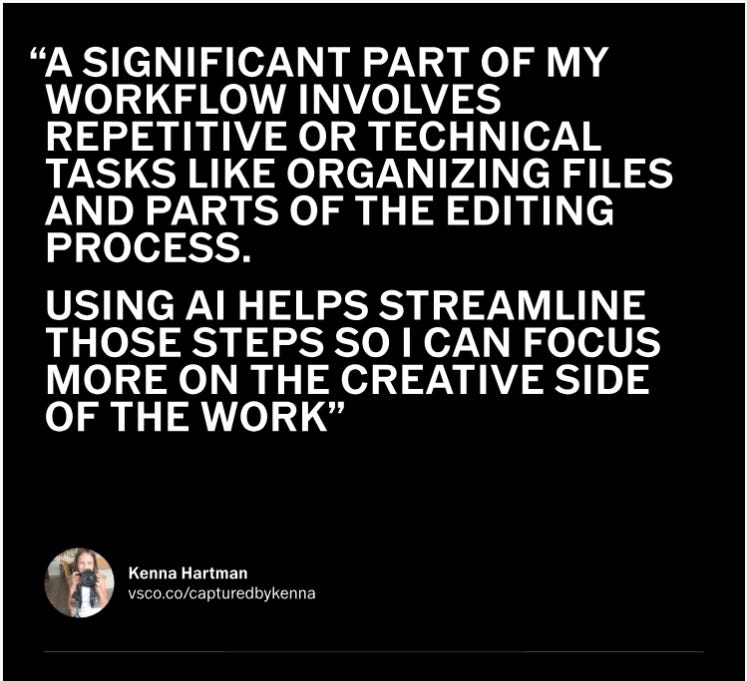
VSCO surveyed 401 photographers in the United States and Canada in December 2025, including working photographers and enthusiasts, and reported that 83% used AI. Respondents also expressed concerns about creative control and ethics. In the report’s examples, Kenna Hartman describes help with file organization and editing; other examples include AI concepts and composites.
Adobe’s research specifically categorizes removing distracting background elements, compositing, and color or tone retouching as generative-AI uses among U.S. photo professionals. Zenfolio’s report describes AI use concentrated in emails, captions, and marketing, with editing and culling ranking lower.
These reports involve different respondents and categories. I suspect that familiar task names also affect how people describe their use, although the reports don’t establish whether that happened among their respondents. Before treating the findings as a disagreement, I’d want to know more about what each question invited people to count. The phrase “I use AI for workflow” leaves considerable room for interpretation.
Getty’s public Creative-contributor FAQ adds a practical example. It permits limited retouching with AI tools and modification with traditional tools, while rejecting files created or modified using generative AI models. Familiar-looking corrections can fall under different submission rules because of the process used. I’ll return to Content Credentials and C2PA in the next issue, including what Lightroom and Photoshop can record about generative editing and how saving or exporting affects the information available.
What the word carries locally
In Tucson, the conversation also has a history outside the photograph.
Project Blue, the data center development near the Pima County Fairgrounds, brought water, electricity, and public participation into the discussion. I noticed a sharper reaction to AI around that controversy and think it contributed to the atmosphere I encounter.
I saw merit in parts of the original water proposal. The city’s July 2025 summary described a reclaimed-water supply that included remediated groundwater from the Tucson Airport Remediation Project (no doubt, the PFAS in the groundwater needs to be dealt with and nobody else was offering to pay for it), along with infrastructure the developer would fund. Putting treated water to use was worth considering. I had concerns about the public process. To me, the proposal arrived with the feeling that officials had already worked out the deal. The city’s own summary acknowledged that nondisclosure agreements had constrained information sharing. Regardless of whether or not the data center might be a good fit for the location, by keeping it secret until it felt too late for the community to offer input, they virtually guaranteed public backlash.
The council rejected the agreement in August 2025 but the project continued on county land, redesigned around air cooling, which uses far less water and more electricity. Construction began this spring. The developer says the campus is for cloud computing, not AI. I’m not sure the word leaves room for that distinction and it’s hard to trust that whatever they say today, they won’t change their plans once the data center is complete.
When someone hears AI and thinks about a data center, the conversation includes decisions about their community. Explaining how AI helps my small business doesn’t make those community concerns go away, especially when my tools rely on that exact same computing infrastructure.
Explaining the process
The University of Arizona research adds another complication.
In 13 experiments involving more than 5,000 participants, researchers Oliver Schilke and Martin Reimann found that disclosing AI use reduced trust across several situations. Explanations involving limited use or human review didn’t eliminate the effect. Having someone else expose the use produced a worse response.
The experiments suggest a cost to disclosure without telling me how a particular client or colleague will respond. They give me a reason to question VSCO’s advice that “Clients care about results, not tools.”
A clear explanation of a process can help someone assess it. They may understand the process and choose a different boundary, whether their concern involves authorship, training data, labor, or resources. I’d love to know how much of the pushback comes from a murky explanation of how AI was used, and how much is a fundamental disagreement that no amount of transparency would fix, but the data remains elusive.
Why I keep sharing what I learn
The AI Daily Brief episode about AI champions gave me a useful description of something I already do. The discussion focused on people inside organizations who explore the tools, identify applications in their colleagues’ work, and help others learn. Knowing the work and evaluating whether a method helps are part of the role.
I run my photography business on my own, but this newsletter serves a similar purpose among peers. I test things in the context of my practice, work through the problems, and share what I find. My learning has sometimes been a slog. Someone starting now has very different tools from the ones I started with. Some of the underlying questions remain: what information a tool needs, how to evaluate its answer, and whether the result helps with the work you intended to do. Those are lessons I can offer without asking anyone to repeat the whole journey.
Building the PPA workshop also served a professional purpose: bringing my teaching experience up to date with the work I do now. No one registered, so I didn’t earn the merits, and I turned the curriculum into a self-directed guide for paid subscribers. PPA still listed the workshop and linked to my work, which put my name on this topic with the organization that certifies me. I think there’s value in serious, credentialed photographers engaging thoughtfully with AI and contributing another point of view. My photography experience gives me a context in which to examine these tools. It gives me business questions to test them against and a reason to pay attention to the quality of what comes back.
The audience extends beyond Tucson and Arizona. A photographer on the other side of the world may find something here useful in their business. Their circumstances could be very different from mine, which is another reason to describe the work precisely enough that they can judge its relevance. I believe AI will remain part of professional life and that learning to use it well matters. People who have no interest today may look for help later. The work I publish now gives them something to return to.