

In 1884, the Supreme Court had to decide whether a photograph could have an author.
The photograph was Napoleon Sarony’s portrait of Oscar Wilde, and the objection probably sounds more familiar now than it should. A photograph came from a machine. The camera performed the mechanical act. How, then, could the person standing behind it claim authorship?
Sarony had an answer. He had selected Wilde’s pose and expression, arranged the costume and accessories, chosen the lighting, and composed the scene. The lower court found that the photograph came from his “original mental conception,” and the Supreme Court concluded that photographs could receive copyright protection when they represented the “original intellectual conceptions” of the author. The camera made the photograph possible. Sarony made the decisions that produced this photograph.
We seem to be having a version of that argument again, except this time the machine is considerably more complicated. Anthropic recently began marking content created with newer Claude models, including Content Credentials for supported files and a separate watermarking approach for text. The details matter, and some of them are still being developed, but the basic purpose makes sense. If AI-generated material can move through the world looking like material that wasn’t generated by AI, giving people some way to know that a model participated is useful.
I don’t think Anthropic is wrong to do it. I think we’re stopping too early. We’re building increasingly sophisticated systems that can tell you which machine touched a piece of work while doing nothing to tell you which person stands behind it, and that is where I think they went wrong.
We’ve done this before
Open a Word document and look at its properties. Mine will say that Michael Kloth created it. It may show who last saved it, when it was created, when it was modified, how many revisions it has been through, which program created it, and other pieces of a record that most of us never look at unless we have a reason to. None of that proves I wrote every (or any) sentence. The field establishes a useful baseline that I’m the person associated with it. The application that created the file is another fact about the document, but Microsoft Word doesn’t become the author because I used it.
Photographers already work with a richer version of this. When I make a photograph with my Canon camera, the file carries information about the camera, lens, exposure, ISO, focal length, date, and other details of the capture. When I bring that file into Lightroom Classic or Photoshop, I can add my name, copyright information, contact information, and other IPTC metadata. Adobe’s Content Credentials work goes further, allowing creator identity and editing activity to travel with supported files in tamper-evident form.
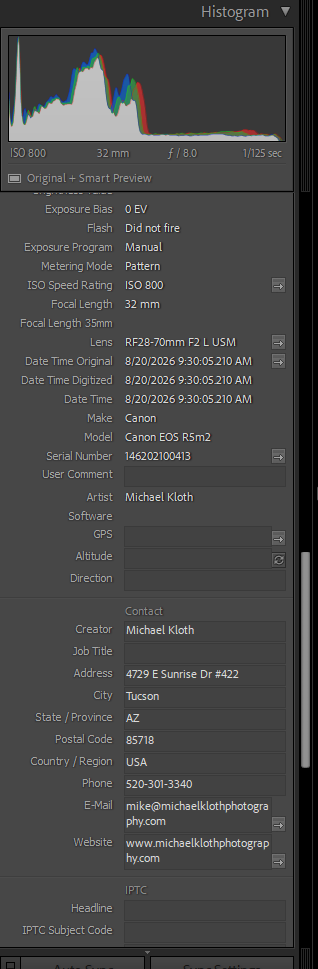
That’s useful to me even before anyone else sees it. If I’m trying to remember how I handled an image five years from now, the record has value. If I’m working in photojournalism, where the difference between an acceptable adjustment and an alteration that changes the meaning of a photograph can matter enormously, the record has another kind of value. If I’m making fine art and want to replace half the sky, nobody needs the metadata to stop me. A provenance system can preserve enough information that a person can make the judgment appropriate to the work.
The strange direction we’re taking with AI
Generative AI should make that kind of record richer. Consider the process behind this article. I didn’t wake up, type a one-sentence prompt into ChatGPT, and receive the thing you’re reading. The idea started when I learned about it while I was walking my dog, then I started doing research to understand the specifics. Further, I worked through it in conversation which included rejecting some offered directions. I changed the central argument because I am a photographer. I brought knowledge that I gained in graduate school, then reinforced when I taught the history of photography at Washington State University. I could do that because that’s the field I know well enough to recognize the parallel. Neither Claude, nor ChatGPT suggested that line of reasoning at all, but if I’d done any part of this writing in Claude, it would have made that a part of the record.
A system capable of participating in all of that can preserve a record far more useful than “Revision 12.” Storage isn’t the meaningful constraint it once was. The private record could contain drafts, notes, source relationships, substantial revisions, tool participation, decisions that disappeared from the published version, and enough information for me to reconstruct how a piece developed six months or six years later An author writing a novel might want exactly that. Why did this character make that choice in chapter nine? The answer may have disappeared from the final manuscript, but it might still exist somewhere in the development record.
That doesn’t mean I want to publish the record. Photography already gives us the model for that too. I can strip EXIF metadata from an exported image. I can preserve only copyright and contact information. I can share more when provenance matters and less when it doesn’t. Word lets me remove document properties before a file leaves my computer. The richest possible creation record and the richest possible public record don’t need to be the same thing. I want the first one for myself. For the second, I want control.
Text makes the second part harder than photography does, and that matters because Word only gets us so far. A photograph usually leaves my workflow as a file, and the file itself is what I publish. The Word document holding this article won’t be the thing you read on Substack. The text will leave that container and become markup on a web page. The author field, revision history, editing time, and anything else attached to the .docx stay behind on my hard drive. Signing the authoring file is easy. Keeping that identity attached when the writing leaves the authoring file is the problem and any serious system for text provenance has to cross that boundary.
The missing assertion
The public version could still be much simpler. Michael Kloth stands behind this work. These tools participated in making it. Here is the credential that connects those statements to this version of the work. That isn’t a fantasy standard waiting for somebody to invent it. The Creator Assertions Working Group has developed an Identity Assertion specifically designed to let a named actor prove control over a digital identity and document that person’s relationship to a C2PA asset independently of the software or hardware generating the C2PA claim. CAWG also has a Metadata Assertion for binding things photographers already understand, including EXIF, IPTC, and XMP metadata, into a tamper-evident record. Its Identity Assertion 1.2 became a ratified specification in December 2025. The word independently matters.
The ordinary C2PA claim signature comes from the claim generator, the vendor’s software or hardware. CAWG separates the named person’s identity claim from that vendor-generated claim. It doesn’t eliminate certificate authorities or every other dependency in a trust system, but it means the application company doesn’t have to be the only party capable of saying who stands behind the work.
Nikon supplied an unexpectedly good demonstration of why that distinction matters. In August 2025, Nikon launched its Authenticity Service for the Z6III. A vulnerability surfaced almost immediately, the service was suspended, and Nikon subsequently told early users that the digital certificates issued during the affected period would be invalidated. The Content Credentials already attached to photographs under those certificates could no longer be used as proof of provenance. Nikon eventually restored the service, which is available today. The photographs hadn’t changed, the photographers hadn’t changed, something upstream in the trust system had.
That’s the danger in treating vendor-controlled attestation as sufficient. I don’t expect any provenance system to be indestructible, and revocation exists for good reasons, especially when somebody finds a vulnerability. But my claim that I made my work shouldn’t depend entirely on the continuing validity of a software or camera company’s claim about it. The infrastructure is moving toward something better. The individual creator still feels like the missing link.
Copyright has always been about the person
Copyright sits surprisingly close to the beginning of the American system. Article I of the Constitution gives Congress the power to secure exclusive rights to authors and inventors, and Congress passed the first federal copyright law in 1790. The details have changed repeatedly since then, but Congress hasn’t exactly developed a reputation for getting ahead of technological change.
Streaming had already remade the economics of music by the time Congress passed the Music Modernization Act in 2018. The law created a blanket licensing system for digital music services and a new Mechanical Licensing Collective, with formal roles for publishers, professional songwriters, digital services, and songwriter advocacy organizations. Technology created the problem, but a lot of organized interests had to agree on enough of a solution to get something through Congress.
Photographers have their own example that’s probably more useful here. For years, suing over a relatively modest copyright infringement meant going into federal court, which isn’t much of a remedy when the cost of enforcing the right can exceed the value of the infringement. PPA, ASMP, and other creator organizations spent years pushing for a small-claims alternative. PPA described a push lasting more than a decade and, during Senate meetings in 2020, said it was speaking on behalf of 30,000 photographers. ASMP documents more than 38,000 emails and tweets to members of Congress, testimony before Congress, Hill meetings, and coalition work with PPA, NPPA, the Copyright Alliance, the Authors Guild, and other groups. Congress finally passed the CASE Act in 2020, creating the Copyright Claims Board inside the Copyright Office.
One photographer in Tucson wasn’t going to create that system. Thirty thousand photographers represented by an organization had a better chance, and it was still a heavy lift for the people involved. That matters now because copyright law is again trying to describe authorship while the technology underneath creation changes quickly.
As of August 2026, the Copyright Office still points to its January 2025 report as its current analysis of copyrightability and generative AI. Its position isn’t that using AI poisons a work. AI-assisted work can receive copyright protection when a human determines sufficient expressive elements, including through creative selection, arrangement, or modification. Material determined entirely by the machine doesn’t receive the same protection, and prompts alone generally don’t establish authorship. There are unresolved questions inside that standard, but the basic principle should sound familiar to photographers. A machine can participate in making an image without becoming the photographer.
The trust problem
We’re trying to answer those authorship questions while dealing with a second problem at the same time. People don’t trust a lot of what they see. Some of that distrust predates generative AI by years. Some of it comes from synthetic photographs, synthetic video, fake quotations, fabricated news, automated social accounts, and enough low-effort generated writing that “AI slop” has become ordinary vocabulary.
LinkedIn, which has no particular incentive to discourage people from creating content for LinkedIn, said in May that it was seeing more low-effort AI-generated material that could sound polished while lacking a unique perspective or substance. LinkedIn’s own framing is close to the distinction I’ve been making: using AI to help write is fine, but the post still needs to represent the person’s voice and perspective. The company says its early testing correctly identified generic content 94 percent of the time. That sounds encouraging until you start asking the questions a creator has to ask. LinkedIn didn’t publish a false-positive rate in that announcement. It didn’t tell us how often an original piece gets caught by the same system, or what recourse a creator has when a classifier decides incorrectly.
This is the same underlying problem showing up from another direction. AI detectors ask whether a model probably produced something because that’s a question they can attempt to measure. Provenance systems tell us that a generative tool participated. Those are useful facts and I’d rather have them than not have them, but neither fact identifies the person responsible for what I’m reading. If the public record says Claude, OpenAI, Gemini, Grok, Photoshop, or Firefly, we’ve identified a production tool. We’ve done roughly the equivalent of identifying my Canon camera while leaving the photographer field blank. It’s no wonder that people treat the work as though a machine made it.
Photographers already know ISO
Photographers have an accidental head start on understanding why the standards work matters. ISO is the International Organization for Standardization. We interact with one of its standards constantly whether we think about that organization or not. The ISO speed setting on a digital camera comes from a standardized system for assigning and reporting camera sensitivity. The current digital-camera standard is ISO 12232. We don’t need to know the committee structure every time we change from ISO 100 to ISO 800. We need different cameras, software, labs, manufacturers, journalists, archivists, and everyone else in the chain to have enough shared agreement that the number means something.
Content Credentials are already much further into that process than “somebody should come up with a standard.” ISO’s current project page lists ISO 22144, *Authenticity of information, Content credentials*, under ISO/TC 171/SC 2 at stage 30.99, approved for registration as a Draft International Standard. C2PA participates with that subcommittee as a Category A liaison. The process isn’t finished, and an ASIS&T standards review voted no with comments during an earlier fast-track review in 2025.
The distinction inside that standards work matters. ISO 22144 is carrying the core C2PA Content Credentials architecture toward an international standard. CAWG’s creator Identity Assertion exists alongside that work as its own ratified specification, designed to plug creator identity into a C2PA manifest. The creator layer isn’t imaginary and it doesn’t require starting over. It just isn’t the thing the whole system is organized around.
OpenAI and Google are already C2PA steering-committee members, alongside Adobe, Microsoft, Meta, Amazon, Sony and others, so the companies building generative systems aren’t absent from this conversation. That makes the omission more interesting, not less.
Who gets to be the author?
Sarony’s camera didn’t diminish his authorship because the camera was never where authorship lived. It lived in the decisions. That’s messier with generative AI because the machine contributes more. I can ask for alternatives I wouldn’t have produced on my own. I can accept a sentence substantially as generated. I can reject twenty others. I can use one model for research, another for a first pass, rewrite the result myself, bring it back for criticism, and publish something that no single participant in that chain could accurately claim to have produced alone. That makes provenance harder and it also makes it more important.
“AI was used” is probably going to become less informative as AI disappears into ordinary software. Phones already make computational decisions every time we make a photograph. Photoshop has had algorithmic tools for years. Word checks grammar. Lightroom masks subjects. Cameras assemble exposures. The line between tool and maker has never been as clean as we sometimes pretend it was, and the vision was never about the tool anyway.
I want the record. I just don’t want the record to erase me. A useful system would let the private provenance become as rich as the technology makes possible, then let the creator decide which parts belong in public. It could retain the tools and meaningful edit history without requiring me to publish every conversation, abandoned draft, or note that got me there. When the work leaves its original container, the creator assertion needs some way to make that trip too. That last part may be the hardest problem in the whole argument, but hard isn’t the same as impossible.
Ssomewhere in that transition, before we get lost in which model produced which token, the finished work should preserve the thing that copyright law, photography, publishing, and creative practice have been trying to identify for a very long time. The person willing to put their name on the work.